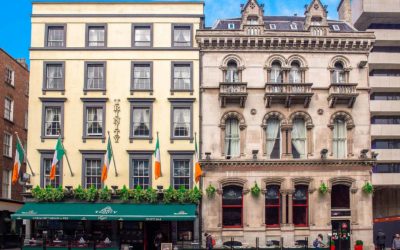
Temple Bar is a 10-block cultural quarter on the south bank of the River Liffey in central Dublin. Bounded by the Liffey to the north, Dame Street to the south, Westmoreland Street to the east, and Fishamble Street to the west, it’s the city’s most-visited neighbourhood and the densest concentration of pubs, galleries, restaurants, and live music venues in Ireland.
If you’re staying anywhere in central Dublin, you’ll end up in Temple Bar at some point. Better to know what you’re walking into before you do.
What Temple Bar actually is
Despite the name, Temple Bar is a neighbourhood, not a single pub. It got its name from Sir William Temple, a 16th-century English teacher and philosopher who served as Provost of Trinity College Dublin. He built his house and gardens on reclaimed land here, and his son Sir John Temple expanded the estate in the 1650s. “Bar” referred to the raised sandbank along the Liffey.
What it is now is Dublin’s cultural quarter — two renovated squares (Meetinghouse Square and Temple Bar Square), a cluster of cultural institutions (the Irish Film Institute, the National Photographic Archive, the Project Arts Centre), and the city’s densest pub and restaurant scene.
The honest bit first
Temple Bar is touristy. The pubs on the main drag are crowded, often loud, and the drinks are the most expensive in the city. The famous red-fronted “Temple Bar Pub” is one of the most-photographed buildings in Ireland and one of the more tourist-trappy pubs to actually drink in.
But Temple Bar is also genuinely fun. The cobbled streets, the street musicians, the gallery openings, the sheer density of things to do — it works. The trick is knowing where to go, not whether to go.
What to do in Temple Bar
Drink a pint (but not at the famous pub)
The famous Temple Bar Pub on the corner of Temple Bar Square is a sight in itself, but €7-8 a pint and a queue out the door. Better: The Palace Bar (Fleet Street, just off Temple Bar) — gorgeous Victorian pub, no phones at the bar, the best pint in the area. Trinity Bar Venue on Dame Street is the local pick — sister venue to Dublin Citi Hotel, live music most nights, no tourist markup.
For the proper trad session, our Dublin pubs with live music guide has the full breakdown of where to actually drink for the trad music experience.
Eat
Temple Bar’s restaurants are mostly mid-range tourist places, decent but not exceptional. A few worth knowing:
- Gallagher’s Boxty House — traditional Irish, the boxty (potato pancake) is the move
- The Quays — gastropub, the fish and chips is good
- Yamamori — Japanese, surprisingly good for the area, big portions
- Bunsen — the best burger in Dublin, no frills
- The Palace Bar — pub food at lunchtime, classy
For something quieter, walk 5 minutes south to Trinity Bar Venue on Dame Street — proper Irish food, locals, and you’ll be back in your hotel room in 2 minutes if you’re staying at Dublin Citi.
See something
Temple Bar isn’t just pubs. Worth a visit:
- Irish Film Institute (IFI) — arthouse cinema in a beautiful old building, the bar is a great spot for a quiet drink
- National Photographic Archive — free photography exhibitions, often surprisingly good
- Project Arts Centre — contemporary art, free
- Gaiety School of Acting — occasionally open for tours, has produced some famous Irish actors
- Meetinghouse Square — the central square, weekend markets in summer, free outdoor films some evenings
When to go
Weekday evenings (Tue-Thu): The best balance. Lively but not crushed. Most pubs have live music.
Friday and Saturday nights: The chaos. Fun if you want it, exhausting if you don’t. Hen and stag parties dominate, the famous Temple Bar Pub is shoulder-to-shoulder from 9pm.
Sunday to Wednesday: The quiet days. Many pubs still have live music, the streets are calm, you can actually walk down the cobbled lanes without dodging people.
Daytime (before 5pm):strong> Underrated. The cobbled streets in afternoon light are genuinely beautiful, most of the cultural institutions are open, the pubs are quieter, the city feels different.
Where to stay near Temple Bar
The right answer is one street back from Temple Bar. The same walkable location, but quiet at night. Dublin Citi Hotel on Dame Street is in this sweet spot — 5 min walk to the Temple Bar action, 2 min to Trinity Bar Venue, family rooms available, and the kind of mid-range hotel that doesn’t try to be trendy.
For a full breakdown of neighbourhoods and where to stay, our where to stay in Dublin guide has the full picture.
Temple Bar FAQ
Is Temple Bar safe at night?
Yes. It’s busy, well-lit, and full of people out for the same thing you are. Standard big-city awareness, nothing more.
How much is a pint in Temple Bar?
€6-8 depending on the pub. The famous Temple Bar Pub is the most expensive (€7-8), the locals’ pubs on the edges are cheaper (€5-6). Trinity Bar Venue on Dame Street is good value.
Is Temple Bar worth visiting?
Yes, but not for the reasons most guidebooks say. Go for the cobbled streets, the cultural institutions, the street musicians, the pubs you actually want to drink in. Skip the famous red pub and the stag-party strip.
What’s the best time to visit Temple Bar?
Weekday evenings (Tue-Thu) for the best balance. Sunday afternoon for the calmest experience.
Can kids visit Temple Bar?
Yes, during the day. Most pubs welcome families before 7pm. After 9pm it’s adult time.
Is Temple Bar the same as Temple Bar Pub?
No. The Temple Bar Pub is one specific pub. Temple Bar is a neighbourhood of about 10 cobbled streets. The pub is the most famous building in the neighbourhood.
Final take
Temple Bar is one of those places that delivers more than the reputation suggests — if you go in knowing what you’re doing. The famous red pub is a photo, not a destination. The real Temple Bar is the local pubs on the edges, the cobbled lanes in afternoon light, the cultural institutions that don’t make the guidebooks, and the trad sessions that start at 9pm and run until close.
Go once. Stay an hour or two. Drink at the locals’ pubs. Walk the cobbled streets in daylight. Then come back at night for a trad session if you’re up for it. The rest of Dublin is 5 minutes away in any direction — our 3-day Dublin itinerary covers how to do the rest of the city.